You need a grown-up, a child aged 6–9, a coloring tool and a few minutes. Start with our free Piano pattern finder sample. It is one prototype page, so you can try the activity today while Color, Clap & Count is coming soon. No piano or music-reading experience is needed. Sit together, let the child lead the color choices, and stop whenever you are ready.
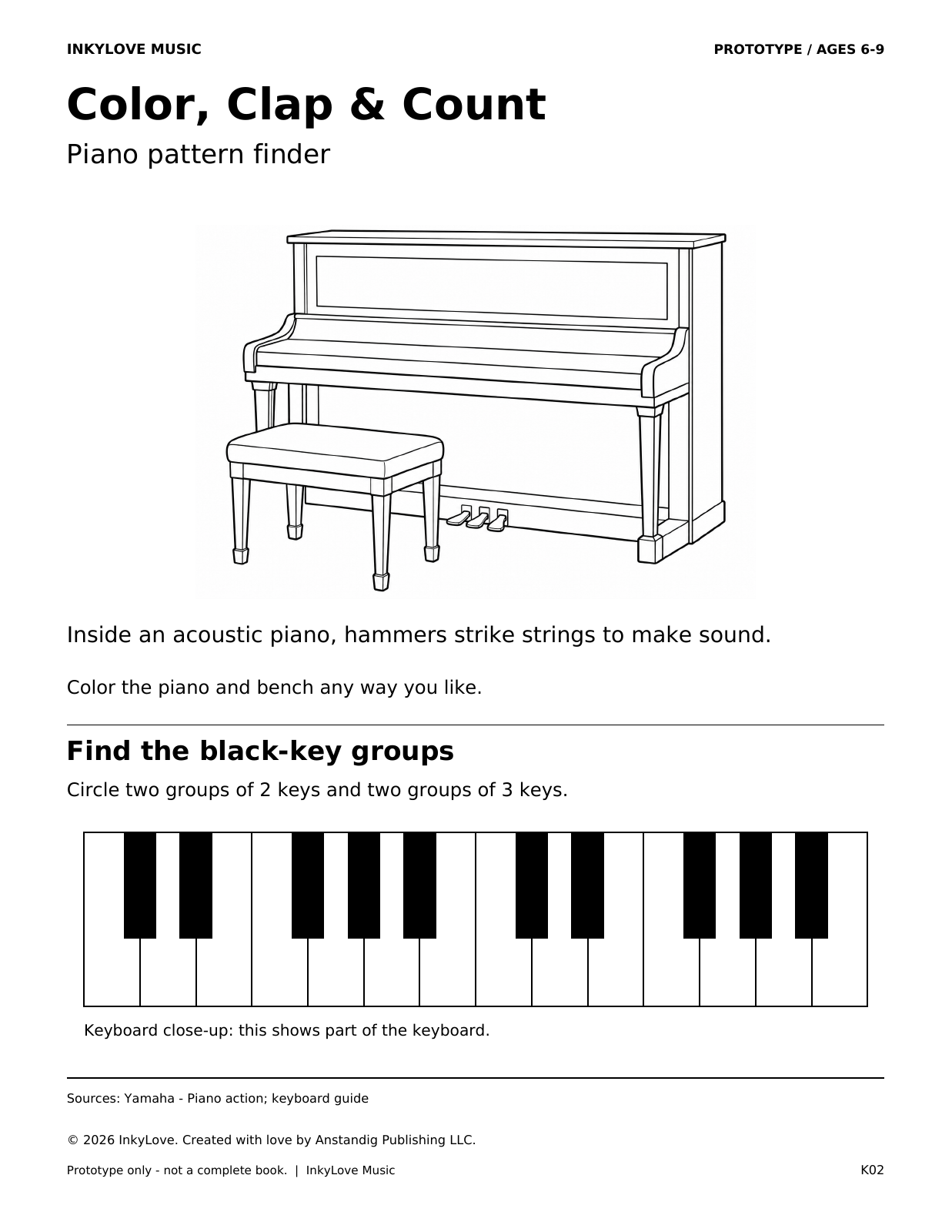
The sample shows an upright piano and, below it, a close-up of part of a keyboard. Its black keys repeat in groups of two and three. You can use the drawing as a visual pattern, even if you never make a sound.
1. Find and color — about two minutes
Look at the big piano first. Ask, “Which part would you like to color?” The child might choose the wide front panel, bench, or pedals. A grown-up can color a neighboring shape, or simply hold the page steady. There is no required piano color.
Now move to the keyboard strip. Point to one group of two black keys. Ask the child to find another, then look for two groups of three. The sample has room to circle the groups gently. If the child would rather keep the page clean, point or trace just above the keys instead. Notice the repeating two, three, two, three shape together; there is no need to name any notes.
2. Make four beats — about one minute
Say “one, two, three, four” at a comfortable pace. For the first round, clap once on each number. For the next round, choose a softer way to mark the beat: tap a knee, touch fingertips together, or move one finger in the air. The grown-up can lead once, then offer the child a turn. Keep the pace easy enough that both of you can follow it.
Want a quiet round? Point to four spots on the table instead of making a sound. The shared pattern is the activity; volume is optional.
3. Invent a tiny pattern — about two minutes
Draw four simple boxes on scrap paper, or hold up four fingers. Let the child choose a mark for “clap” and a different mark for “quiet.” Fill the boxes together, one choice per box. Try the pattern once while counting one through four, then repeat it. A quiet box can mean hands resting, a still finger, or a silent point. Switch one box and try the new version. Which version would you choose for another turn?
If four choices feel like too many, the grown-up can offer two options for each box. If drawing is awkward today, say the choices aloud or point as the grown-up marks them. A child who prefers watching can choose the order while the grown-up performs it.
Colored pencils work well for the sample’s smaller keys; crayons are easy for the broad piano panels. If you use markers, place a protective sheet behind the printed page. A blank reverse does not make ordinary paper bleedproof. Print on paper that suits your printer and coloring materials, and keep this one-page prototype labeled as a preview.
Want to see where this idea goes? Preview Color, Clap & Count for an actual violin page and a short silent look at three book pages. The complete book has 30 music designs for ages 6–9; its 72-page paperback and 42-page printable editions are coming soon. Purchase links will appear on that page when available.
Keyboard reference: Yamaha Musical Instrument Guide. The sample shows only part of a keyboard.